

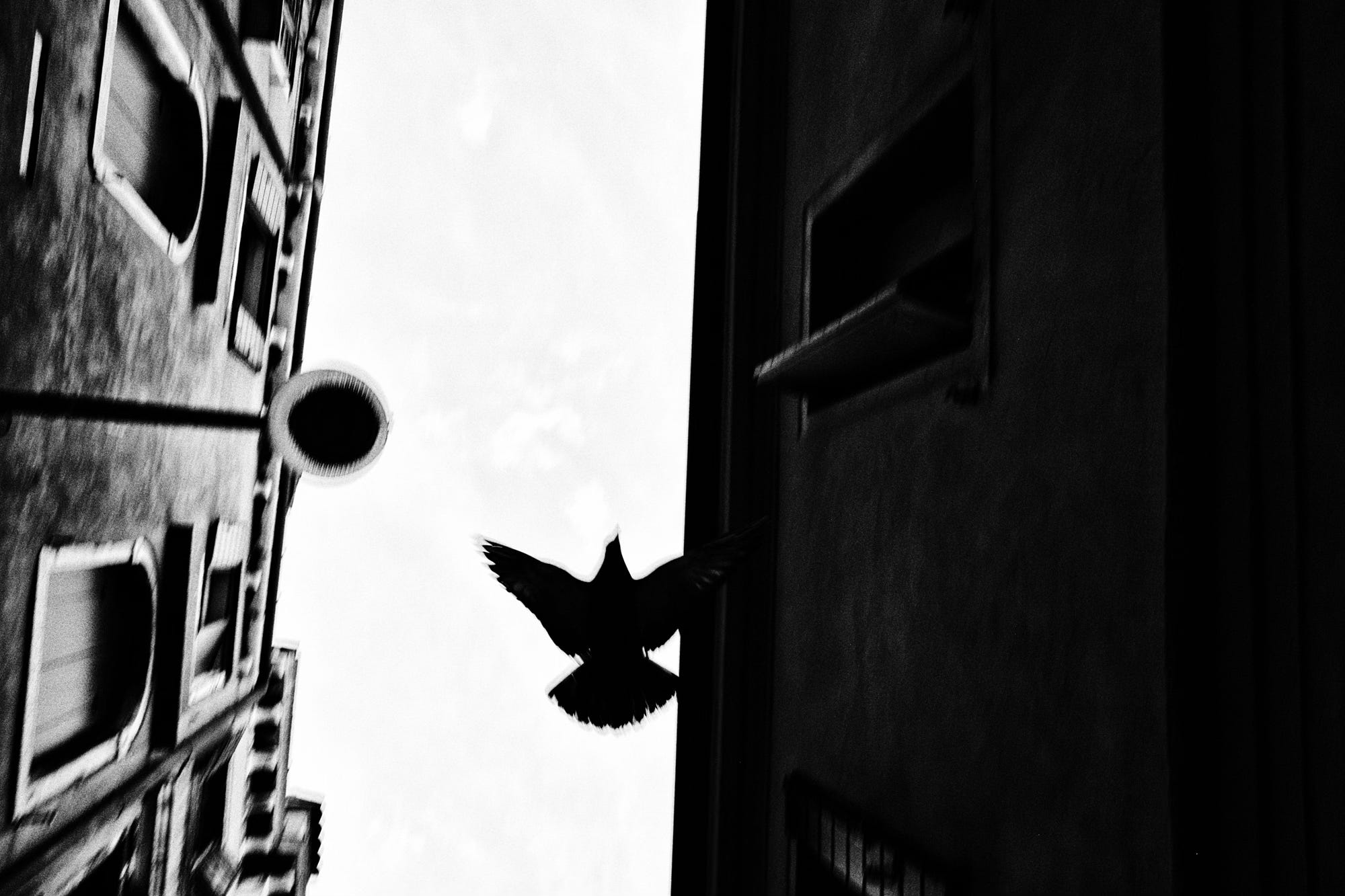
I didn’t take this photograph because I had a plan.
I took it because, for a brief moment, the world in front of me felt complete — and I’ve learned to trust that feeling before my mind starts negotiating with it.
Venice is full of images that almost take themselves. The obvious ones. The ones the city serves up daily, beautifully, endlessly. But that day I wasn’t looking for “Venice.” I wasn’t hunting canals or postcards or anything that would instantly explain where I was. I was walking, looking, letting the city be what it really is most of the time: tight streets, tall walls, narrow slices of sky, surfaces shaped by years of weather and footsteps.
I noticed the structure first.
On the left: a building leaning into the frame, textured and busy, full of information. On the right: a darker plane, heavy and quiet, almost blank by comparison, like a curtain pulled across the scene. Between them: a bright vertical cut of sky. It wasn’t a view so much as a ready-made stage — simple, graphic, and slightly tense. Light versus dark. Detail versus silence. Two worlds, separated by a thin corridor of air.
That’s usually how it starts for me: not with a story, but with a feeling of balance. Something about the geometry makes me lift the camera before I can talk myself out of it. I’m not thinking about meaning yet. I’m thinking about edges, weight, contrast. I’m thinking, this might hold.
And honestly, for a moment, that was enough. If I had pressed the shutter right then, I would still have had a photograph I liked — a photograph about space, about compression, about Venice as a kind of vertical labyrinth. But then the bird appeared, and the picture changed from “strong” to “alive.”
No warning. No choreography. Just a sudden black shape cutting into the white space at exactly the point where the frame needed a heartbeat. That’s the part I can’t manufacture, and it’s also the part I keep coming back for.
People sometimes misunderstand this kind of photography. They think it’s pure luck — the world hands you a perfect moment, and you happen to be there. Or they think it’s pure intention — every element planned and arranged. For me, it’s neither. It’s readiness.
It’s walking and watching until you find a frame worth committing to — and then staying with it long enough for something to happen inside it. A shadow shifts. A person enters. A glance turns. A dog pauses. Or, in this case, a bird crosses the only clean piece of sky you’ve been given.
That’s why I took this photograph: because I was already saying yes to the structure, and then the city added a final gesture I couldn’t have invented.
I like that the bird isn’t a “subject” in the usual sense. It doesn’t turn the image into a bird photograph. It’s more like punctuation — a quick mark that finishes the sentence. Without it, the image is about surfaces and edges. With it, the image becomes about time.
And I think that’s what I’m always chasing, even when the pictures look quiet: that thin line where the solid world and the moving world touch each other. The place where geometry meets accident. The moment when something static gets interrupted — not ruined, not complicated, just made real.
When I look at this frame now, I remember the feeling more than the location. The narrowness of the street. The cool shade. The bright opening above. The small sense of release you get when you tilt your head back and find air.
And then the simplest instinct: now.
I didn’t take this photograph to prove anything. I took it because I was paying attention, and something fleeting completed the frame. Because I’ve learned that if you hesitate, these gifts vanish and leave you with a version that’s merely “nice.”
So I press the shutter when the sentence finishes itself — even if I’m not fully sure yet why it matters.
Sometimes the “why” comes later.
Sometimes the why is simply this: I was there, I was awake, and for half a second the world aligned.
Until next time,
Tomasz
In all due respect, I have to question the concept of a photograph needing an explanation like this. It’s a personal journey, introspective and deep, but perhaps most relevant to the photographer and not necessarily the audience. Let’s be honest, if anyone was drawn to this image, in a gallery, it would be in wonderment of why it was there. I’m not drawn into the narration at all, sorry. But here I am, discussing it and occupying my mind with it. So to that end, It’s touched me, not necessarily as intended.
Muy oportuna y conseguida