

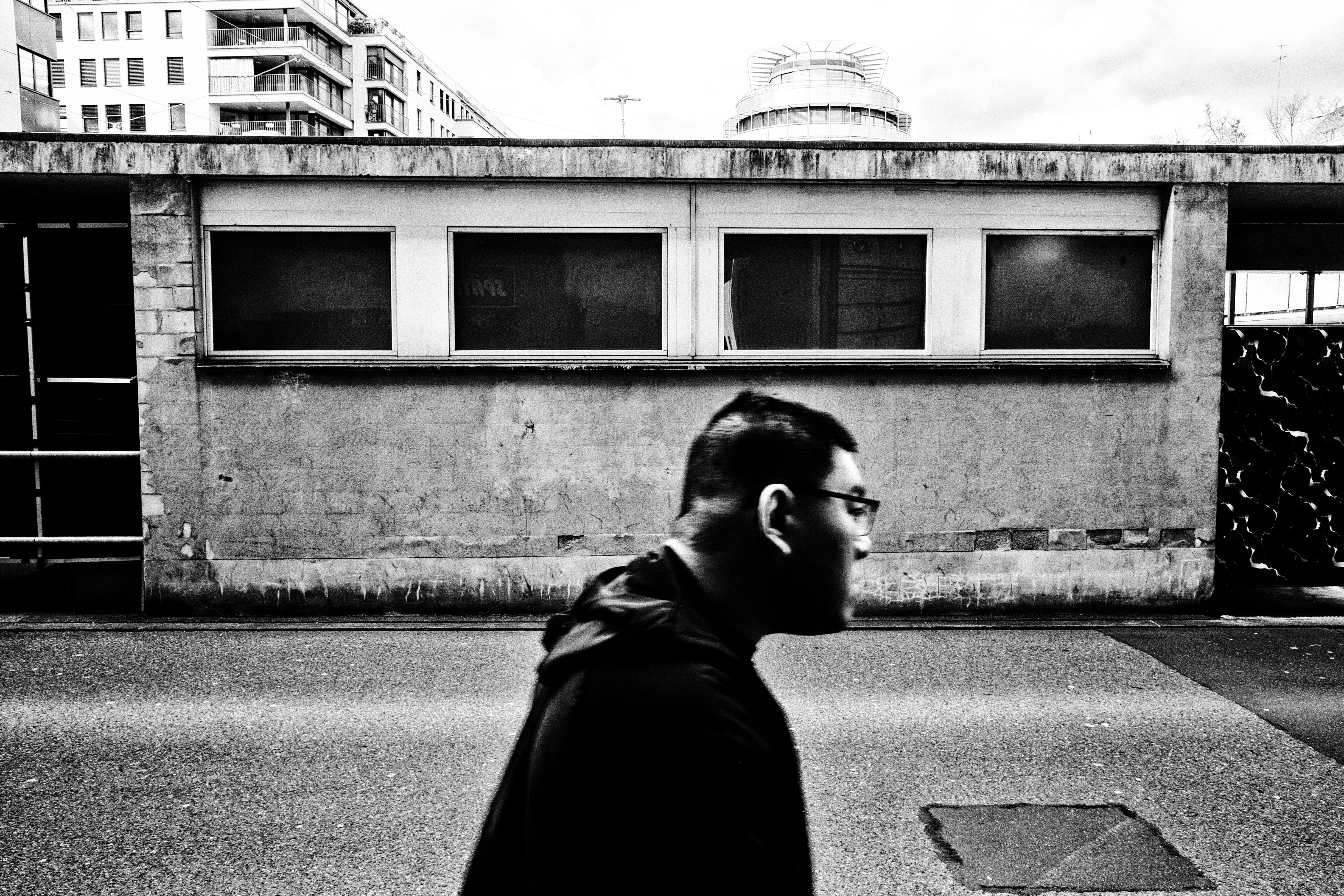
Here is my Sunday thought.
One of the things I love most about photographs is that they never tell us everything.
We see a man passing through the frame. We see the dark shape of his body, slightly blurred, moving quickly across a hard urban background. Behind him, there are windows, stains, walls, fragments of buildings, a strange mixture of order and decay. But we do not really know anything.
We do not know where he is going.
We do not know what he is thinking.
We do not know whether this was a good day, a difficult day, or just another ordinary day.
And maybe that is exactly why the photograph holds our attention.
So much of life is incomplete when we see it. We catch fragments. A face in profile. A gesture. A shadow. A person walking past us on the street. For a second, another human being enters our field of vision, and then disappears again. We will never know their story. We are left only with the shape of their presence.
Photography understands this very well.
It does not need to explain. It does not need to give us the full biography, the full context, the full answer. Sometimes a photograph becomes stronger precisely because it refuses to close the circle. It leaves space for us. It allows us to wonder.
And I think this is also one of the quiet differences between looking and consuming. When we consume images, we want them to be immediately clear. We want the point. The message. The reason. But when we really look at a photograph, we accept that some things will remain unresolved.
This man passed through my frame.
For a fraction of a second, he belonged to the picture.
Then he was gone.
But in the photograph, he is still there — moving, anonymous, unfinished.
And maybe that is enough.
Until next time,
Tomasz
I've long preferred to think that photos rarely tell a story, but point at a story to be told.
You are right from the artist's point of view, but the photo is a document at once, and the photographer should take that into account. Ansel Adams said, "Not everybody trusts paintings but people believe photographs." That is true, so sometimes photos, with or without meaning, are used for manipulation. A shining example is Afghan Girl by Steve McCurry - the story that was not told.
The NPPA Code of Ethics reads:
"Be complete and provide context when photographing or recording subjects. Avoid stereotyping individuals and groups. Recognize and work to avoid presenting one's own biases in the work."
So, to complete the story, we should include at least a brief comment on the works we have shown. There is nothing unfinished in your photo of the pedestrian - you told us your story, and this moment is finished for us. Someone might say, "So hard a life for Asians in Switzerland; he is tired and sad..." But we will not believe that because we already have your comment - we, with you, do not know who he is, where he is going, or what he is thinking.
By the way, it is nice work, as usual!