

Here is my Sunday thought.
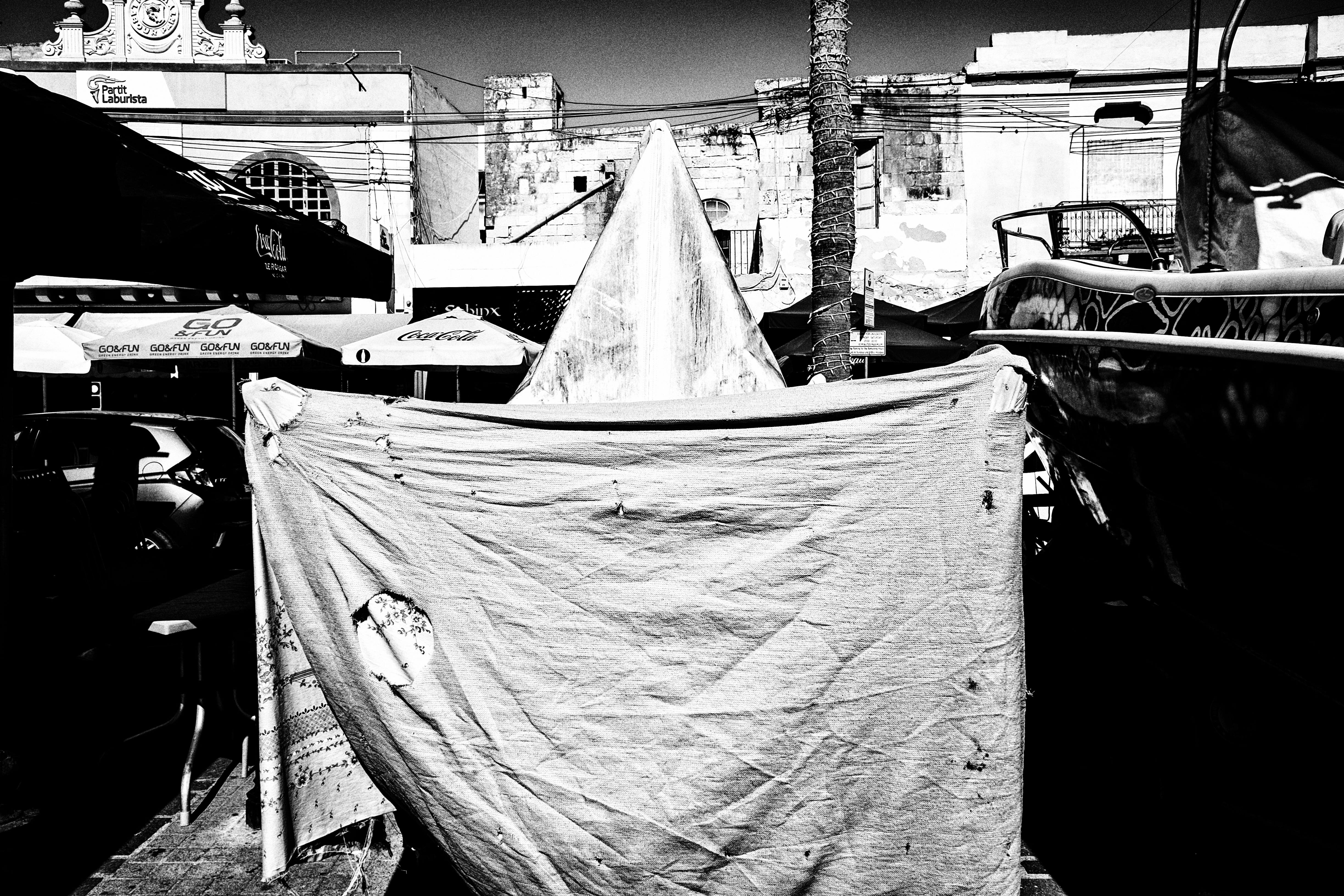
A few days ago, I took the photograph above in the fishing town of Marsaxlokk, in Malta.
This image surprised me twice.
The first surprise happened when I saw the scene. I was drawn to it immediately for purely visual reasons: the rough cloth hanging in the foreground, the pointed white form behind it, the dark mass on both sides, the wires cutting across the frame, the old walls, the palm tree, the little pockets of light and shadow. It felt like one of those accidental street arrangements I love most — messy, layered, slightly absurd, and yet somehow held together by form. I was thinking about textures, tension, shapes, contrast. Nothing else.
The second surprise came later, after I shared the photograph.
Some American viewers saw something I had not seen at all: the silhouette of a Ku Klux Klan hood. A few people even called the image provocative. I was genuinely taken aback. Not because I wanted to deny their reading, but because that association had never entered my mind for a second while making or editing the photograph. My attention had gone somewhere completely different.
And that, to me, is fascinating.
We often talk about photographs as if they were clear containers of intention. The photographer sees something, frames it, shares it, and the viewer receives it. But that is not really how photographs work. A photograph may begin with the photographer’s intention, but it never ends there. It travels. It lands in other minds, other histories, other places. It meets memories the photographer does not have. It touches nerves that may not even exist in the photographer’s own cultural world.
A picture is never seen in a vacuum.
It is seen through a life.
An American viewer may carry a very different visual memory than I do. Certain shapes will immediately trigger associations rooted in that country’s history, trauma, violence, and iconography. Someone from somewhere else may see none of that and respond instead to geometry, atmosphere, or symbolism of another kind. Neither reaction is invented out of nowhere. Both are real. Both come from somewhere deep.
This is one of the reasons photography remains so interesting to me. It is not only about what is in front of the lens. It is also about what is already inside the person who looks.
We like to believe that seeing is simple. But seeing is not simple at all. It is filtered through upbringing, education, geography, media, language, fear, memory, religion, politics, family stories, and private experience. The same photograph can appear poetic to one person, threatening to another, and visually neutral to someone else. Not because one person is right and the others are wrong, but because photographs are unstable by nature. They are open forms. They invite projection.
That can be uncomfortable. It can also be humbling.
As photographers, we do not fully control the meanings our images will generate once they leave us. We can be careful. We can be thoughtful. We can be honest. But we cannot completely govern the cultural baggage a viewer brings to the frame. Sometimes a photograph reveals more about the viewer than about the subject. Sometimes it reveals more about the world the image enters than about the world in which it was made.
I find that both unsettling and beautiful.
Unsettling, because it reminds me that photographs are never innocent objects floating above history. Beautiful, because it shows how deeply alive they are. A photograph is not finished when the shutter clicks. In some ways, it begins there. Then it continues inside other people.
And maybe this is worth remembering the next time we feel too certain about what a picture “means.”
Sometimes a photograph is not only a record of what we saw.
It is also a record of who we are when we look.
Until next time,
Tomasz
This personal Sunday thought makes me stop and think about the real energy of a photograph, Tomasz. Thank you for your insights. Keep them coming!
I am not American, but my first thought was "It's lile a Ku Klux Klan..."